
First off, sorry for the late late post on Zara. Got distracted with stuff.. but here goes.
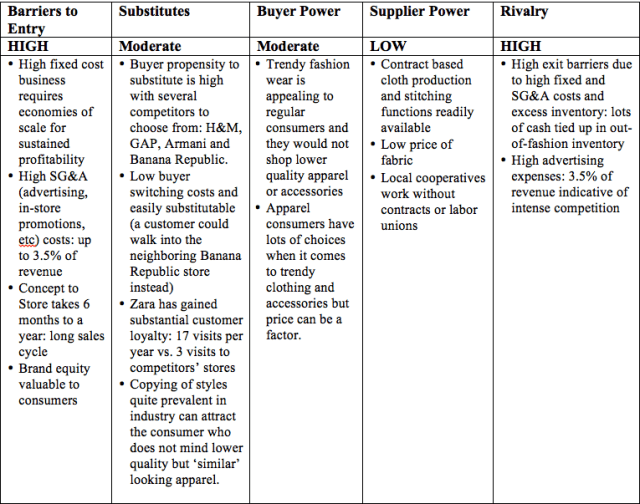
Overview of the determinants of industry profitability (Porter’s Five Forces Analysis)
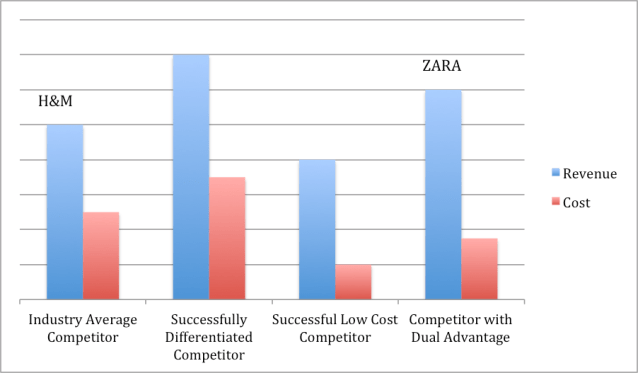
Zara’s competitive position can be quickly summarized using the chart below, where it is seen that Zara has a dual advantage over its competitors: generates more top-line revenue (in 2008 it became the largest fashion retailer in the world surpassing GAP), maintains low cost manufacturing and distribution networks (goes from concept to store in 15 days on average, 10 to 12 times faster than closest rivals, H&M and GAP[1] respectively with a 17.4 factor-advantage over advertising costs[2]).
[1] H&M takes 3 to 5 months from creation to delivery: 5*30/15=10 factor advantage. GAP data given in case. [2] Industry average: 3.5% of revenue spent in advertising. Inditex spends 0.3%, 67% of this cost attributed to Zara. 3.5%/(0.3%*.67) = 17.4 factor advantage.
Competitive position & strategy
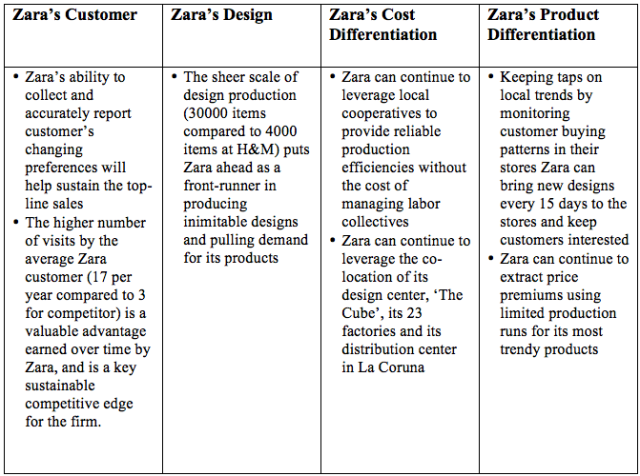
The strategic choices Zara has made and the competitive levers afforded to it by way of implementing these strategies is documented in the table below (the color-coded activities are mutually reinforcing):

[3] H&M creates 2000 to 4000 designs per year compared to 30000 designs by Zara at La Coruna, ‘The Cube’. [4] 1/8th of dollar volume is contracted out to Turkey and Asia. [5] Zara gains up to 3 hours of prime selling time over competitors, assuming an 8 hour window that translates to a 5/8=37.5% advantage vs. competitors. [6] Avg. industry markdown is 50% (=markdowns/net-sales), therefore about 50% of garments are NOT soles at full price. Zara sells 85% of its products at full price, and therefore generates maximum margins on 35% more of its products than competitors do.[7] Customer visits: Zara is 17 times versus 3 times a competitor. [8] The case mentions 2% of work hours, which would- for hourly employees, it is assumed- translate to 2% on variable and direct labor costs
Extent to which activities mutually reinforce each other
- Store managers using PDA data and relaying data into POS terminals
- Using technology to handle complexity and minimize errors
- These two reinforce each other to a very high degree. Technology is used pervasively by Zara, both in stores and in the distribution center at La Coruna (and Zaragoza)
- Inventory control using limited production runs
- Hanger signaling system lets savvy customers identify newer apparel
- These two work hand-in-hand because a savvy customer knows the item in a black hanger wont last that long, and is willing to pay the full price to look differentiated
- Garment ranking system and demand forecasting using customer feedback
- 50% of production fabric is received undyed at La Coruna
- Receiving undyed fabric lets Zara control for demand fluctuations in the short-term
- Zara is better able to respond to changing local and national tastes by receiving undyed material, and then working with local cooperatives to stitch together customizations identified using the POS customer data collected in stores.
Potential for conflicted choices
- Manufacturing in-house: There is inherently some risk in producing 40% of total fabric and 60% of merchandise in-house at La Coruna. Zara is exposed to demand fluctuations, supply-side distortions like oil price hikes that could derail the carefully syndicated and orchestrated logistics. However, Zara manages to stay ahead by using forecasting techniques, and incorporating customer feedback into creating those forecasts.
- Ironing clothes in advances, paying extra to pack them in hangers imposes some cost to Zara, and is a sunk cost if the garments are not sold. However, Zara controls for this outcome by limiting production and cycling through inventory every 2 weeks or so.
Sustainability of Zara’s apparent competitive advantage
The following factors contribute to the sustainability of competitive advantage:
Vertical integration rationale
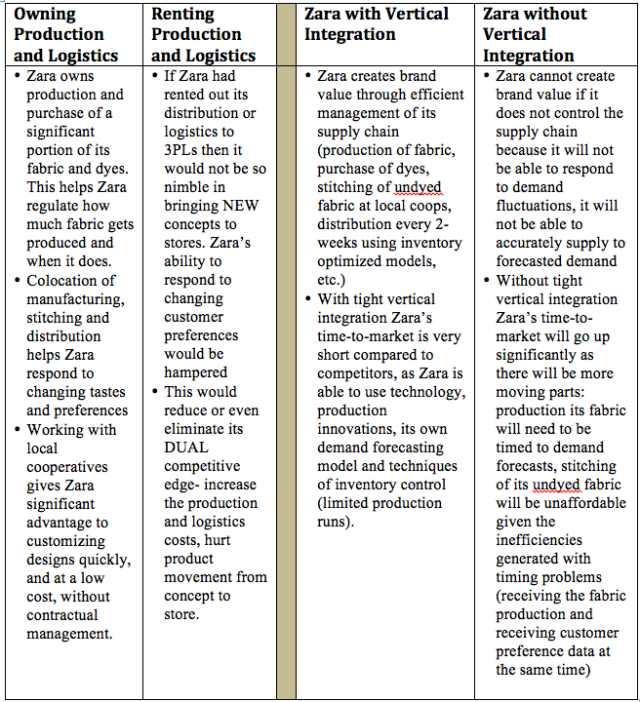
Choosing a high degree of vertical integration has several advantages for Zara: it helps to correct market imperfections such as eccentric consumer behavior (e.g. switching patterns driven by Hollywood releases), helps to create levers for Zara to pull (or regulate) in order to manage inventory in times of demand and supply distortions and helps Zara extract maximum margins on its products. The following table details these and some other advantages of vertical integration for Zara.
 The Berkeley MBA
Hi there! I cannot click on the reference superscripts for 7 and 8. Please could you tell me where you got this data?
I remember the data being a part of the case.
Hi, is there any evidence that supports your figure of average Zara customer visits?
Yes, it was a case exhibit – don’t think I can cite it here though. Thanks for reading.
I want to cite this article from your website in APA. Can you help me with this?
Could you please explain the two points below in simple words?
Zara can contribute to leverage local cooperatives to provide reliable production efficiencies without the cost of managing labor collectives
Zara can continue to leverage the co-location of its design center, ‘The Cube’, its 23 factories and its distribution center in La Coruna
Thanks a lot in advance.
I have noticed you don’t monetize your website, don’t waste
your traffic, you can earn additional bucks every
month because you’ve got hi quality content. If you
want to know how to make extra $$$, search for: Mrdalekjd methods for $$$