
Walter Elias Disney entered the entertainment industry when he and his brother, Roy started a studio in Hollywood. He had, by then, already experimented with animating characters using newer “cel” based technique which was better than the contemporary “cutout” based animations. His characters at Laugh-O-Gram studios had been extremely popular in Kansas City but he could not sustain the business due to extremely thin margins. In Hollywood, even though he lost rights to the Oswald character and many of his best animators, Ub Iwerks- the original designer of Oswald- never left his side. After losing the rights to Oswald, Disney felt the need to develop a new character to replace him, which was based on a mouse he had adopted as a pet while working in his Laugh-O-Gram studio in Kansas City. Ub Iwerks reworked the sketches made by Disney to make the character easier to animate although Mickey’s voice and personality were provided by Disney himself. They said that “Ub designed Mickey’s physical appearance, but Walt gave him his soul”. Disney enjoyed much success with cartoon characters through the 1940s but also expanded operations to full length cartoon feature films, and diversified into other media in the 1950s.
In the aftermath of World War II, Disney sought out new revenue streams such as creating training and educational cartoons for the government, re-releasing Snow White which accounted for significant portions of their revenue in 1944. This was an epiphany for the company and proved the everlasting popularity of their main characters. Disney had indeed established a brand and the magic lay in the characters which they could now leverage to diversify into complementary and some not-so complementary businesses.
After WWII, Disney started mixing live action and animation scenes in their full-length dramatic movies. Disney also created the Walt Disney Music Company to create the music for its productions which is still a great example of backward vertical integration. As Disney’s film successes ensued and profitability increased they created their own distribution company, Buena Vista Distribution, resulting in tremendous savings on distribution fees and giving us a great case study in forward vertical integration. With a strong share of market in the media business and now connected to a fairly efficient distribution network that they owned, Disney entered the TV market with Disneyland and the Mickey Mouse Club. The expansion to TV was a key corporate strategy that created substantial leverage for the company because it already had a captive audience by then. The TV market entry brought them renewed public attention, interest from influential investors that it used to garner momentum for the next big break- the Disneyland theme park. The theme park was a fundamental shift in how the entertainment industry operated until Disney came along and created a gateway for fun for all ages. Of course, with all this expansion came the problem of managing the portfolio of companies each strife with unique challenges.
Business Strategy
All companies must develop a set of criteria to identify business units that should be evaluated for divestiture. These criteria should include financial performance metrics, but must also consider cultural and strategic elements. We recommend Disney ask the following questions to help arrive at their decision. Are better alternatives available? Is the market opportunity large enough? Is this business a good strategic fit – is it aligned with our core values? How much money must be invested to make the business successful? Is the business profitable? Honest answers to these questions will uncover inconsistencies in the business model that may only be corrected by divesting business units.
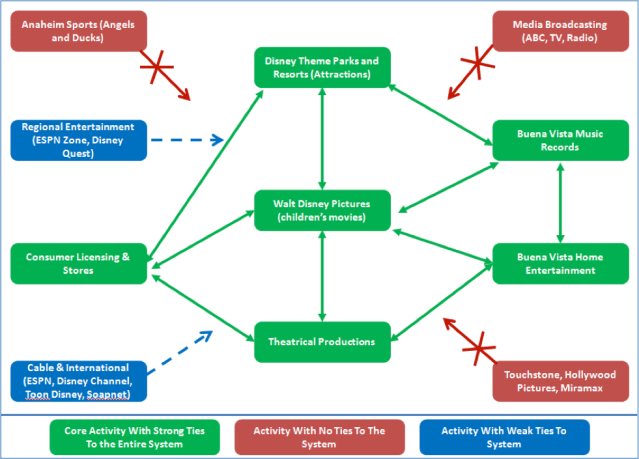
Exhibit 2 shows a map of Disney’s key activities and demonstrates their connection to the core parts of Disney’s business, theme parks and animated movies. Much of Disney’s popularity is derived from the creation of animated characters and children’s films. Disney needs to divest from activities which don’t align with its core strategy of providing wholesome family entertainment. They risk brand dilution if they continue with businesses that contradict their wholesome corporate image.
Recommendations
1) Divest ABC/Media Broadcasting Studios – Financially, ABC is showing negative trends that make it a divestment consideration. From 1995 to 1997 (before and after purchase of ABC), ROE declined from 23% to 12%; while a decline in ROE can be expected from the additional debt ($9B) (Exhibit 1), the decrease in operating income is cause for concern. ABC Network provides limited, and potentially negative, synergy for Disney, which is overshadowed by the negative spillovers it generates. For example, the rising cost of sports programming, including a $9 billion increase to broadcast NFL games, has made the synergy less valuable. Although the merger of ABC and Disney’s Touchstone saved the company an estimated $50 million per year, it created a culture clash which impacted the overall effectiveness of the company and caused creative talent to leave. A company that strives on its ability to be creative and unique cannot afford such key losses. The merger also stifled ABC’s business potential by limiting favorable alliances since it could no longer partner with program developers like DreamWorks. ABC fell from top ranked before the merger to third place in 1997. In 1999, they jumped back to the first place riding on the back of one supremely successful show. However, it is doubtful this success can be sustained, and they would be wise to take advantage of the increased valuation provided by this one-hit wonder. ABC, in its current state, lacks a compelling financial or strategic value proposition, and should be divested.
2) Divest Miramax / Touchstone / Hollywood Pictures – The core value of Disney is its brand image for high quality mainstream, family entertainment. Disney has been extremely successful in selling this image to the public through its amusement parks and animated films. There is no strategic fit between Disney’s core and the type of movies that Miramax, Touchstone and Hollywood Pictures produce. Controversial productions like Pulp Fiction will hurt Disney’s image and competitive advantage. The potential profits that could come from a top movie are not worth the brand damage that may come with being associated with this non-core asset.
3) Divest Anaheim Sports – The Anaheim Mighty Ducks created positive synergies when Disney made sequels to The Mighty Ducks movie. However, this is not a synergy that could be sustained over the long term. Also, the team has become a financial burden to Disney. The same argument holds for the Angels. Although the sports franchises may provide positive synergies with ESPN Zone and the hotel onsite at Disneyland, it is doubtful that the financial losses incurred from running the teams will be worth the tradeoff.
Exhibit 1: Operating Income as a percentage of sales and Debt Equity composition
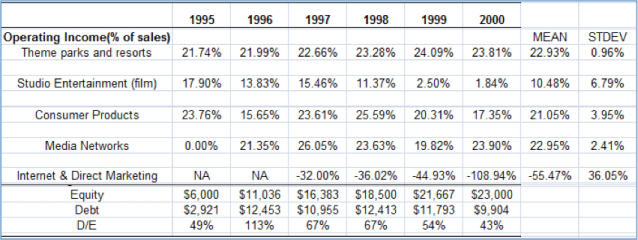
Exhibit 2: Disney’s Activity System
 The Berkeley MBA
I was extremely pleased to uncover this page. I wanted to thank you for your time for this particularly wonderful read!! I definitely savored every part of it and i also have you saved to fav to check out new information on your site.